
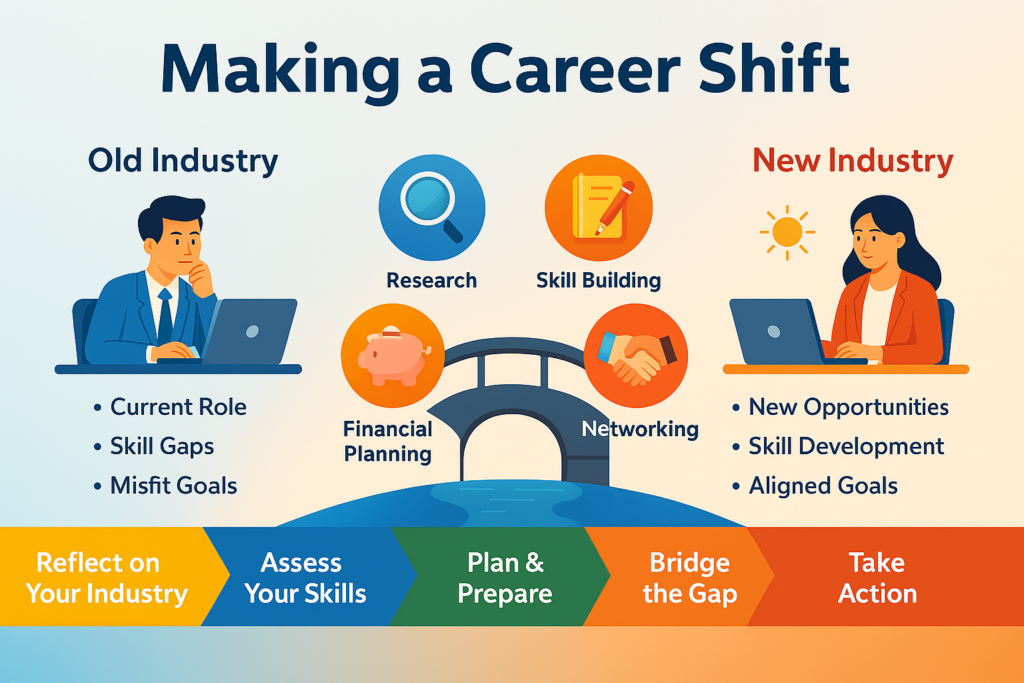
Career shifts are becoming increasingly common. Rapid technological change, evolving industries, and shifting personal priorities have encouraged professionals across age groups to rethink their paths. Moving into a new industry is no longer unusual — but doing it without clarity can be risky.
A successful career shift is less about bold leaps and more about thoughtful preparation.
Why Career Shifts Are Increasing
Industries are transforming faster than ever. Automation, digitalisation, and new business models are reshaping job roles. Fields like data analytics, sustainability, digital marketing, and artificial intelligence are expanding, while traditional roles continue to evolve.
At the same time, professionals increasingly seek purpose, flexibility, and alignment with personal values. Unlike earlier generations, today’s workforce views careers as dynamic rather than linear.
However, change without direction can lead to instability. Strategy matters.
Start With Clarity
Before switching industries, define your motivation clearly.
Are you moving away from dissatisfaction, or toward opportunity?
Are you reacting to temporary frustration, or pursuing long-term growth?
Clarity prevents impulsive decisions. Write down your reasons for change. Identify what you want more of — learning, income growth, impact, flexibility — and what you want less of.
A well-defined “why” becomes your anchor during uncertain phases.
Identify Your Transferable Skills
A career shift does not mean starting from zero. Most professionals carry transferable skills across industries.
- Communication
- Analytical thinking
- Project management
- Team coordination
- Research
- Client relationship management
- Problem-solving
Instead of focusing on job titles, break your experience into skills. Leading a project in one industry demonstrates leadership and coordination — valuable in many sectors.
The key is reframing your experience in language relevant to the new field.
Research Before You Move
Many career transitions fail due to unrealistic expectations.
- Required qualifications
- Entry pathways
- Skill expectations
- Salary ranges
- Growth potential
Speak to professionals in the field. Attend industry webinars. Read reports and case studies.
Research reduces assumptions. It replaces guesswork with informed decision-making.
Bridge Skill Gaps Strategically
Once you identify the new industry’s expectations, assess your gaps honestly.
Not every transition requires another degree. Often, focused certifications, short-term programs, or practical projects are enough to build credibility.
- Online certification courses
- Portfolio-based projects
- Freelance or volunteer assignments
- Entry-level transitional roles
The goal is to demonstrate capability, not simply collect credentials.
Small, consistent steps build competence and confidence.
Plan Financially and Emotionally
Career transitions often involve temporary adjustments — including income changes or slower initial growth.
Build a financial buffer before making the shift. Plan realistically for timelines. Understand that progress may be gradual.
Emotionally, prepare for self-doubt and comparison. Patience and resilience are essential.
Network With Intention
Opportunities often emerge through conversations rather than job portals.
Connect with professionals respectfully. Ask for insights, not favours. Seek mentors who understand both your current and target industries.
Networking should be exploratory, not transactional.
Career Shift Checklist
✔ Clarity Check
- ☐ I have clearly defined why I want to switch industries
- ☐ My decision is based on long-term growth, not short-term frustration
- ☐ I understand what I expect from the new industry
✔ Skills Assessment
- ☐ I have identified my transferable skills
- ☐ I can clearly explain how my experience fits the new field
- ☐ I have updated my resume and LinkedIn accordingly
✔ Research & Preparation
- ☐ I understand entry-level requirements in the new industry
- ☐ I have spoken to professionals in the field
- ☐ I know realistic salary and growth expectations
✔ Skill Gap Strategy
- ☐ I have enrolled in relevant courses or certifications
- ☐ I am building practical experience or a portfolio
- ☐ I am actively learning industry tools or terminology
✔ Financial & Emotional Readiness
- ☐ I have planned for possible income adjustments
- ☐ I have a savings buffer
- ☐ I am prepared for gradual progress
Insight from Inspirelife.in
A career shift is not a setback — it is often a sign of growth.
Modern careers are rarely linear. What matters is intentional movement, not constant change. Clarity, preparation, and disciplined action reduce risk and increase long-term success.
Changing industries is not about abandoning who you were.
It is about aligning with who you are becoming.
Author & Editor
RK Prashant
Founder, Inspirelife.in