
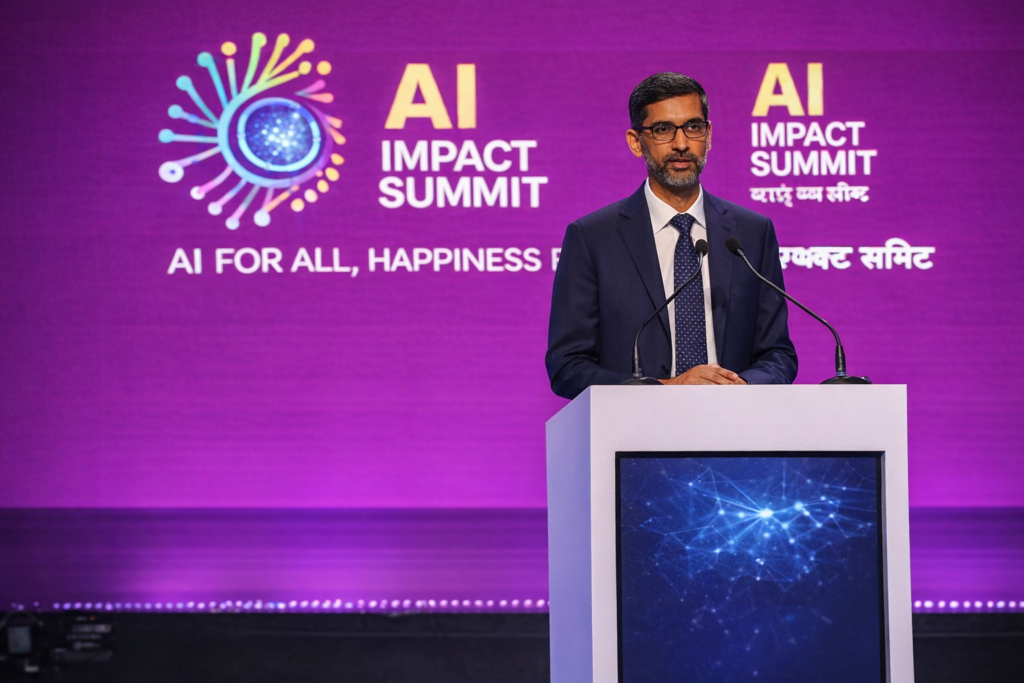
The India AI Impact Summit 2026 was held from 16–20 February 2026 at Bharat Mandapam in New Delhi, bringing together policymakers, technology leaders, researchers, startup founders, and industry stakeholders to discuss India’s evolving artificial intelligence strategy. Organized under the IndiaAI Mission of the Ministry of Electronics and Information Technology (MeitY), the summit focused on AI governance, infrastructure investment, and public-sector AI deployment.
The multi-day event featured keynote sessions, technical discussions, and policy roundtables examining India’s AI compute capacity, regulatory preparedness, startup ecosystem growth, and responsible AI frameworks. Representatives from government agencies, industry bodies, academic institutions, and global technology companies participated in the discussions.
Among the keynote speakers was Sundar Pichai, CEO of Google and Alphabet Inc., who addressed India’s expanding role in shaping global AI standards. The summit comes at a time when countries worldwide are accelerating efforts to build domestic AI infrastructure and regulatory frameworks, reflecting growing recognition of artificial intelligence as strategic national capacity.
Sundar Pichai’s India AI Vision
In his remarks at the summit, Pichai emphasized India’s long-term potential in artificial intelligence and highlighted Google’s commitment to supporting the country’s AI ecosystem.
According to reported coverage of the event, Pichai stated:
“I believe India is going to have an extraordinary trajectory with AI and we are supporting with a full stack commitment, including products, scaling and infrastructure.”
— Sundar Pichai, CEO, Google
The statement reflects Google’s broader strategy of investing in AI infrastructure, expanding cloud capabilities, and supporting digital capacity building within India.
- A large and expanding engineering talent base
- Rapid digital adoption across sectors
- Scalable digital public infrastructure
- A growing AI startup ecosystem
Pichai suggested that India’s AI journey should extend beyond adoption and contribute meaningfully to global AI innovation and governance frameworks.
Emphasis on Responsible AI
A central theme of Pichai’s remarks was responsible AI development.
In practical terms, responsible AI involves building systems that are safe, fair, transparent, and accountable.
- AI systems must be carefully tested to reduce harmful outputs.
- Bias mitigation remains essential across language and demographic groups.
- Users should clearly know when they are interacting with AI systems.
- Companies must take responsibility for AI behavior.
- Human oversight remains critical in sectors such as healthcare, finance, and governance.
He underscored that safeguards should be embedded during development rather than introduced after large-scale deployment, highlighting the importance of maintaining public trust as AI adoption expands.
Investment and Infrastructure Commitment
Google has previously committed multi-billion-dollar investments in India to expand cloud infrastructure, digital connectivity, and AI research capabilities. These long-term commitments align with the summit’s emphasis on infrastructure readiness and national AI capacity building.
The summit also included discussions on expanding domestic compute capacity and encouraging public-private collaboration to accelerate AI deployment across sectors. Such initiatives reinforce India’s ambition to become a significant contributor to the global artificial intelligence landscape.
The Scale of AI Transformation
| Category | Industry Context (2024–2026) |
|---|---|
| Foundation Model Size | 10B – 1T+ parameters |
| Training Compute | Hundreds to thousands of GPUs per model |
| AI Startups in India | 2,000+ AI/ML startups |
| Projected AI GDP Impact by 2030 | $450–500 billion |
| AI Job Growth in India (2021–2024) | 200%+ growth |
Policy, Infrastructure, and Long-Term Competitiveness
Governance emerged as a central theme throughout the summit.
- Data privacy standards
- Bias mitigation frameworks
- Safety testing protocols
- Accountability in AI deployment
- Transparent regulatory systems
Industry leaders emphasized that innovation must advance alongside safeguards. Infrastructure — including domestic computing capacity and advanced cloud ecosystems — was identified as essential for long-term competitiveness.
AI leadership depends not only on technological breakthroughs but also on institutional planning, regulatory clarity, and responsible deployment.
Insight by InspireLife.in
The India AI Impact Summit 2026 reflects a structural shift aligned with India’s broader National AI strategy. Since the release of NITI Aayog’s National Strategy for Artificial Intelligence and the subsequent rollout of the IndiaAI Mission, India has signaled its intention to build sovereign AI capacity rooted in infrastructure, research, and inclusive deployment.
As Sundar Pichai highlighted responsible AI at the summit, the broader message extended beyond corporate investment or technological scale — it emphasized the importance of building artificial intelligence systems that are safe, inclusive, and institutionally aligned with national policy objectives.
- Applied AI startups building sector-specific solutions
- Academic and research partnerships advancing foundational innovation
- Venture capital supporting scalable ventures
- Multilingual AI systems serving India’s linguistic diversity
- Workforce reskilling initiatives preparing professionals for AI-integrated industries
India’s leadership in artificial intelligence will likely be defined not solely by model size or compute capacity, but by how effectively innovation integrates into governance, industry, and public systems while maintaining trust and regulatory clarity.
The summit reflects India’s stated objective of contributing to global AI standards — not only as a fast-growing digital economy, but as a policy-driven participant shaping how artificial intelligence scales responsibly across diverse societies.
R.K. Prashant
Author & Editor, InspireLife.in